

When Self-Defense Becomes a Crime
An Ontario man, Jeremy McDonald, was charged with aggravated assault and assault with a weapon after he injured a home intruder who was allegedly armed with a crossbow. The incident has ignited a national debate in Canada about the legal definition of “reasonable force” and whether the law is failing to protect homeowners who are defending themselves against an armed threat.









The idea that a home is a place of absolute safety is a cornerstone of Canadian life. A recent incident in Lindsay, Ontario, has cast a harsh light on this belief, sparking a national debate about where the law stands when a citizen is forced to defend their own life.
In the dead of night, a man named Jeremy McDonald was confronted by a home intruder reportedly armed with a crossbow. In self-preservation, Mr. McDonald fought back. The intruder was seriously injured.
What followed defied the public’s sense of justice. Instead of being hailed as a hero, Mr. McDonald was charged with aggravated assault and assault with a weapon.
The decision was met with disbelief across the country. Canadians are left to wonder what constitutes “reasonable force” when an armed assailant breaks into your home. This case has become a flashpoint for a public frustrated with a legal system that seems to be punishing a victim while an alleged perpetrator recovers. It is a stark reminder that while the law may offer citizens the right to defend themselves, the consequences can be just as severe as the initial threat.
Join us here on X or here on Facebook to comment on this article.









Business
Unlocking the Canadian Defence Sandbox: How Quinte Innovators Can Use Speed and Local Muscle to Scale
TL;DR: Global defense is moving faster than government bureaucracy. The new Calian 100 million shared lab network gives Canadian startups the ultimate sandbox to build military tech without the red tape. By combining hobbyist parts with local manufacturing powerhouses like the Quinte region small teams can build the next game changing drone before the big guys even finish their paperwork. Read on to find out how.

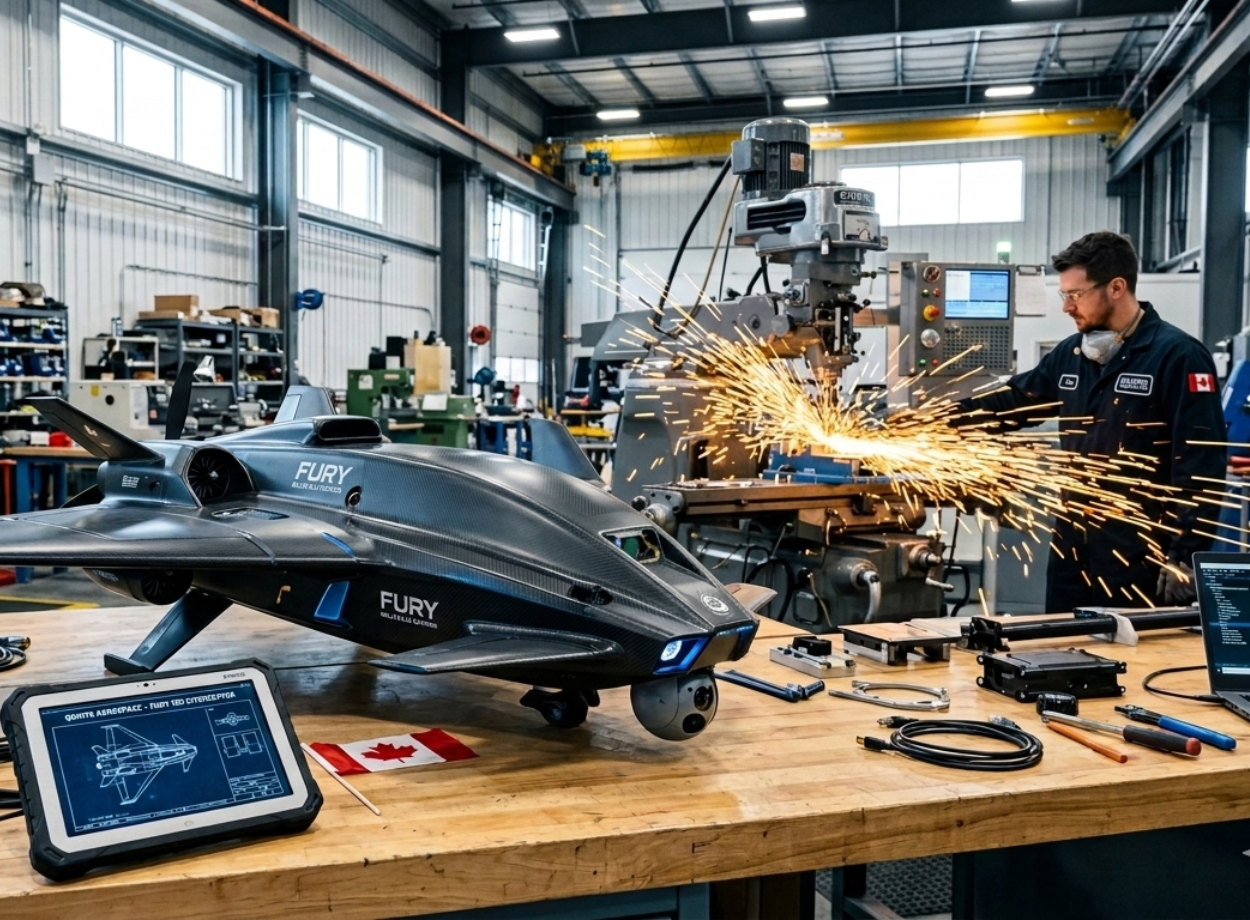
Global conflicts are shifting fast and legacy systems are out. Agility is everything today. Canada needs better integration for crucial priorities like Arctic security. The old procurement process is painfully slow and often leaves brilliant ideas stuck in bureaucratic limbo. We need a rebellion against the old guard.
Enter the Calian Group and Calian VENTURES. They are setting up a 100 million cross-country defense lab network. This fund is a massive toolkit. It opens up the sandbox for agile Canadian entrepreneurs to build domestic tech faster than ever. That means combining speed with modified tech and local manufacturing muscle.
The 100 Million Key Access Integration and the End of Isolation
The Calian initiative is completely changing the game. They are building a physical C5ISRT ecosystem. C5ISRT stands for Command Control Communications Computers Cyber Intelligence Surveillance Reconnaissance and Targeting.
This shared lab model destroys a huge barrier to entry. Small teams no longer need to build multimillion-dollar testing ranges. They can plug prototypes straight into a NATO-ready environment. The real magic here is integration over pure innovation. We do not always need a brand new invention. We just need existing tools to talk to each other across land air sea and cyber domains. Canadian tech often focuses too much on software apps. Real hardware integration is the untapped goldmine and these shared labs are the picks and shovels.
The Blueprint ALM Meca and the Art of the Out of Nowhere Success
Look at ALM Meca as the perfect case study. They are a small 17 person precision machining company in France. They built the Fury 120 interceptor drone completely under the radar.
They bootstrapped the whole thing with zero initial government funding or venture capital. They kept their intellectual property and moved at their own pace. Their genius move was using custom precision machined micro turbojets. These are engines popularized by remote control jet hobbyists rather than expensive military hardware. They focused on pure speed to defeat cheap loitering munitions. The drone hits 700 kilometers per hour and they built it in under a year.
Garage tinkerers and local machine shops are the new defense contractors. Being outside the prime contractor system gives small companies a massive advantage. They can embrace radical low cost thinking that huge defense giants simply cannot execute quickly.
Translating the Model The Quinte Region and the Local Loop Advantage
We can do this right here in Ontario. The Quinte region and Belleville are manufacturing powerhouses. We have serious advanced manufacturing sectors with strong machining electronics and materials supply chains. We also have great innovation resources at places like Loyalist College.
Belleville is a sleeping giant of advanced manufacturing just waiting for tech startups to knock on the door. We need to create a local loop. Imagine an agile aerospace startup teaming up with a Belleville manufacturing shop. Instead of waiting years for a massive prime contract they build a high performance prototype fast and locally. They use modified high tech or hobby tech components just like ALM Meca.
Actionable Steps for Quinte Entrepreneurs
Here is the playbook for Quinte entrepreneurs.
First, identify the niche. Focus on specific sub problems. Build secure data links for existing drones or ruggedized edge sensors.
Second, build the agile consortium. Match local tech talent with local manufacturing capacity.
Third, minimize dependence and maximize speed. Bootstrap a minimum viable product to prove your capability before chasing massive funding.
Fourth, target the shared labs. Use your local prototype to prove you have what it takes and then plug into the Calian shared lab network for final validation instead of waiting for a general contract.
Seizing the Sovereign Opportunity
The Calian funding provides the access. ALM Meca proves outsiders can win. Quinte manufacturing is ready to deploy. Defense innovation is a sprint right now and the biggest barrier is a slow mindset rather than a lack of capital. Quinte operators have the tools to build sovereign Canadian defense tech and completely change the game.
What do you think? Are local innovators ready to bypass the red tape and start building? Can Belleville become the next hub for agile defense tech?
Canada
Ottawa Sinks Free Boating: New $24 Fee and 5-Year Renewal Cycle Hits Quinte Waters
TL;DR: Transport Canada has ended the era of free, lifetime pleasure craft licences, introducing a mandatory five-year renewal cycle and a $24 fee effective immediately. The new regulations also force existing lifetime licence holders to transition to the new system by specific deadlines and will expand licensing requirements to wind-powered vessels over six metres by 2027.

Just when we thought we could look forward to a worry-free summer on the Bay of Quinte, Ottawa has decided to drop a new anchor on our wallets.
As of December 31, 2025, Transport Canada has quietly overhauled the Pleasure Craft Licence (PCL) program, effectively ending the era of the “lifetime” boat licence. If you own a vessel with a motor of 10 horsepower or more, the days of a one-and-done registration are over.
For the first time, Canadian boaters are being hit with a $24 fee to issue, renew, transfer, or replace a pleasure craft licence.
While twenty-four bucks might not break the bank for everyone, it is the principle that stings. For decades, licensing your boat was a free, administrative formality—a “thank you” for registering your vessel for safety purposes. Now, it looks suspiciously like another revenue stream flowing directly from our docks to the federal coffers.
The “Lifetime” Licence Myth
Perhaps the most frustrating part of this rollout is the retroactive nature of the changes. If you are sitting on a “lifetime” licence issued years ago, believing you were grandfathered in, think again.
Transport Canada has set a strict schedule to phase out these older licences. For example, if your licence was issued before 1985, it expires in 2026. This forces responsible boat owners, who followed the rules years ago, to jump back through the bureaucratic hoops and pay the new toll.
Sailors, You Are Next
The net is being cast wider, too. Our sailing community on the Trent-Severn and out in the open Bay isn’t safe from the regulator’s reach. Starting December 31, 2027, wind-powered pleasure craft over six metres in length will also require a licence.
This is a massive shift for sailing purists who have traditionally operated outside of these specific motor-vessel regulations.
Red Tape on the Rideau
To add insult to injury, the government has tightened the leash on reporting. You now have a mere 30 days to update your information if you move or change your name, slashed from the previous 90-day window.
They claim this is about “safety,” “accountability,” and managing abandoned vessels. But let’s be honest: does charging a fee and forcing paperwork every five years actually make the water safer? Or does it just create a larger pile of paper in Ottawa and a lighter wallet in Belleville?
For a region that thrives on waterborne tourism and recreation, adding friction to boat ownership is a wet blanket we didn’t ask for. We should be encouraging people to explore the waterways, not nickeling-and-diming them for the privilege.
Is this truly about cleaning up our waterways, or is it just another tax on the Canadian summer?
Join us on X and Facebook to share your thoughts.
Business
How Belleville Could Help Build Canada’s New Auto Industry
TL;DR: Canada can launch a profitable domestic car brand by adopting the “Edison Motors” model of using off-the-shelf parts and decentralized manufacturing. Instead of building massive new factories, a startup could leverage existing suppliers and manufacturers in places like Belleville, Ontario to build a rugged and repairable national vehicle.

Could a startup domestic auto brand spawn outside of boardroom presentations and government committees? The future of the Canadian car industry likely isn’t happening in a glossy office tower in Toronto. A muddy lot in British Columbia where a guy named Chace Barber decided he was tired of waiting for Elon Musk might give a promising hint at the hidden potential future for Canadian automobile manufacture.

Barber is the founder of Edison Motors. He is a trucker who got sick of broken promises from big tech companies so he went to his parents’ backyard in Merritt and built his own electric logging truck. He didn’t ask for permission. He didn’t wait for a billion-dollar federal grant. He just started welding.
Now, Edison is breaking ground on a new manufacturing facility in Golden, BC. They aren’t trying to build 100,000 units in year one to please Wall Street. They are aiming for a realistic, profitable run of 100 trucks in 2026. They are building them for loggers and oil patch workers who can’t afford a battery that dies in -30°C weather.
But the real game-changer is the “Edison Pickup Kit.” Barber knows that not everyone needs a semi-truck, but everyone wants to stop burning cash at the pump. They are finalizing a “drop-in” diesel-electric conversion kit that can turn your existing heavy-duty Ford or Dodge pickup into a hybrid powerhouse. It’s the ultimate recycling program: keep your old truck’s body, gut the tired engine, and install a modern electric drivetrain that generates its own power. It is brilliant, it is anti-obsolescence, and it is exactly the kind of innovation that carries the day.
This is the energy we need to bottle.
Building a car company doesn’t have to require the GDP of a small nation. We don’t need massive factories and years of red tape. Edison Motors proves that. Barber’s philosophy is “Right to Repair.” He uses off-the-shelf parts that any mechanic can fix. He sources axles and generators that already exist and integrates them into a better machine.
The “Edison Model” is the blueprint for a mass-market Canadian car.
We have the supply chain ready to go. The brains are in Waterloo and the manufacturing muscle is already humming in places like Belleville, Ontario.
Belleville could play a large part in this story. It is home to Magna Lighting (operating as Autosystems) on Jamieson Bone Road where they are building world-class lighting components for global brands. It has precision shops like Stegg Limited that can machine complex parts to aerospace and automotive standards. The industrial parks along the 401 in Belleville are packed with fabricators who know how to build things that last.
We don’t need to build a new Gigafactory when we can just connect the dots. Imagine a rugged Canadian SUV conceived in Canada and assembled with parts, components and stamped metal from the Quinte region.
It creates a vehicle that is simple and tough. It uses a standard chassis. It uses reliable suspension. It doesn’t have a proprietary charging port that requires a master’s degree to fix. It is built by us for us.
The government attempt to solve our economic problems with committees and studies. They want try to lure foreign giants with tax breaks. But the real solution is staring us in the face. It looks like a guy in a flannel shirt building a truck because nobody else would do it right.
We don’t need another branch plant. We need a a few more Chace Barbers backed by our own talent and resources.
Are you tired of cars that you can’t fix yourself? Would you buy a car conceived and built in Canada with off the shelf parts?

Unlocking the Canadian Defence Sandbox: How Quinte Innovators Can Use Speed and Local Muscle to Scale
TL;DR: Global defense is moving faster than government bureaucracy. The new Calian 100 million shared lab network gives Canadian startups...


The Ancient Superhighway: How a Tropical Drink Reached the Bay of Quite 2,000 Years Ago
TL;DR: Discover how 2,000-year-old pottery found in the St. Lawrence River reveals a massive prehistoric trade network. Ancient residents of...


From Trenton to Torino! The Quinte Skater Ready to Shock the World
TL;DR: Trenton’s Trennt Michaud has finally hit the Olympic ice in Italy with partner Lia Pereira. After a career-defining pivot...


Stop Grinding Alone: The Secret Support Network for Quinte Business Owners
TL;DR: Starting a business in the Bay of Quinte doesn't have to be a solo grind. Our region offers a...

How to Get Free of the 9 to 5 and Get Rich From Common Chores
TL;DR: This step-by-step guide breaks down how to ditch the grind and build a high-revenue service empire in your own...


The Rail Revolution: Why Belleville Entrepreneurs Should Claim Their Ground Now
TL;DR: Alto is exploring a new southerly loop for its 300 km/h high-speed rail near Belleville. This multi-billion dollar shift...


The latest inductees into the Order of Canada has been released. We take a look at past Bay of Quinte inductees.
TL;DR: The 2026 Order of Canada inductees include pop culture icons like Nardwuar alongside Bay of Quinte legends who have...


6 Predictions for 2026: The Death of Job Hugging and the Rise of the Portfolio Professional
TL;DR: The Canadian dream is getting a massive update as we enter 2026. The traditional 9-to-5 is officially a legacy...


Is your Bay of Quinte property subject to Cowichan-style “clouded title”?
TL;DR: "Cowichan-style" property revolution could hit Ontario, specifically targeting the Bay of Quinte. For local homeowners and investors, the gold-standard...