
News
Long-Standing Canada-USA Agreement Ends
A long-standing agreement allowing Canadian ranchers and farmers to use a road in Montana is ending. The US government is closing the road to Canadians, citing border security. In response, the Alberta government has committed to building a new road on the Canadian side of the border to ensure residents have a reliable route.


For generations, a handshake agreement has kept a border road clear for residents of southern Alberta and Montana. This road, located in the US, is set to close to Canadian access in July 2026. This decision by the US government will force Canadian ranchers and farmers to find a new route.
Border Road is a 15-kilometre stretch located entirely on the American side of the border in Montana. It has served as a direct and efficient route for Canadians in Warner County, allowing them to avoid a significant detour. The long-standing partnership had Americans supplying gravel and Canadians providing maintenance.
The move to restrict Canadian access is part of a broader push to secure the border against illegal activity. Locals on both sides of the border, including those in Montana’s Toole County, insist that criminal issues are minimal in this region. This decision has been met with disappointment, as it places the road’s maintenance burden entirely on Toole County and removes a vital access point for Canadians.
The Alberta government has offered a solution. Warner County Reeve Randy Taylor confirmed that Alberta’s Minister of Transportation, Devin Dreeshen, has promised to fund and build a new road on the Canadian side of the border. This solution will allow producers to operate efficiently without relying on US policy.
Join us on X, Facebook, or Instagram and share your thoughts.
Sources
- Global News. “Southern Alberta residents face loss of ‘Border Road’ used for generations.” Global News, September 3, 2025. https://globalnews.ca/news/11391273/southern-alberta-residents-face-loss-of-border-road/
- CBC News. “U.S. blocking Canadian access to road southern Alberta county has long relied on.” CBC News, August 14, 2025. https://www.cbc.ca/news/canada/calgary/u-s-blocking-canadian-access-to-road-southern-alberta-county-has-long-relied-on-1.7602645





Business
Unlocking the Canadian Defence Sandbox: How Quinte Innovators Can Use Speed and Local Muscle to Scale
TL;DR: Global defense is moving faster than government bureaucracy. The new Calian 100 million shared lab network gives Canadian startups the ultimate sandbox to build military tech without the red tape. By combining hobbyist parts with local manufacturing powerhouses like the Quinte region small teams can build the next game changing drone before the big guys even finish their paperwork. Read on to find out how.


Global conflicts are shifting fast and legacy systems are out. Agility is everything today. Canada needs better integration for crucial priorities like Arctic security. The old procurement process is painfully slow and often leaves brilliant ideas stuck in bureaucratic limbo. We need a rebellion against the old guard.
Enter the Calian Group and Calian VENTURES. They are setting up a 100 million cross-country defense lab network. This fund is a massive toolkit. It opens up the sandbox for agile Canadian entrepreneurs to build domestic tech faster than ever. That means combining speed with modified tech and local manufacturing muscle.
The 100 Million Key Access Integration and the End of Isolation
The Calian initiative is completely changing the game. They are building a physical C5ISRT ecosystem. C5ISRT stands for Command Control Communications Computers Cyber Intelligence Surveillance Reconnaissance and Targeting.
This shared lab model destroys a huge barrier to entry. Small teams no longer need to build multimillion-dollar testing ranges. They can plug prototypes straight into a NATO-ready environment. The real magic here is integration over pure innovation. We do not always need a brand new invention. We just need existing tools to talk to each other across land air sea and cyber domains. Canadian tech often focuses too much on software apps. Real hardware integration is the untapped goldmine and these shared labs are the picks and shovels.
The Blueprint ALM Meca and the Art of the Out of Nowhere Success
Look at ALM Meca as the perfect case study. They are a small 17 person precision machining company in France. They built the Fury 120 interceptor drone completely under the radar.
They bootstrapped the whole thing with zero initial government funding or venture capital. They kept their intellectual property and moved at their own pace. Their genius move was using custom precision machined micro turbojets. These are engines popularized by remote control jet hobbyists rather than expensive military hardware. They focused on pure speed to defeat cheap loitering munitions. The drone hits 700 kilometers per hour and they built it in under a year.
Garage tinkerers and local machine shops are the new defense contractors. Being outside the prime contractor system gives small companies a massive advantage. They can embrace radical low cost thinking that huge defense giants simply cannot execute quickly.
Translating the Model The Quinte Region and the Local Loop Advantage
We can do this right here in Ontario. The Quinte region and Belleville are manufacturing powerhouses. We have serious advanced manufacturing sectors with strong machining electronics and materials supply chains. We also have great innovation resources at places like Loyalist College.
Belleville is a sleeping giant of advanced manufacturing just waiting for tech startups to knock on the door. We need to create a local loop. Imagine an agile aerospace startup teaming up with a Belleville manufacturing shop. Instead of waiting years for a massive prime contract they build a high performance prototype fast and locally. They use modified high tech or hobby tech components just like ALM Meca.
Actionable Steps for Quinte Entrepreneurs
Here is the playbook for Quinte entrepreneurs.
First, identify the niche. Focus on specific sub problems. Build secure data links for existing drones or ruggedized edge sensors.
Second, build the agile consortium. Match local tech talent with local manufacturing capacity.
Third, minimize dependence and maximize speed. Bootstrap a minimum viable product to prove your capability before chasing massive funding.
Fourth, target the shared labs. Use your local prototype to prove you have what it takes and then plug into the Calian shared lab network for final validation instead of waiting for a general contract.
Seizing the Sovereign Opportunity
The Calian funding provides the access. ALM Meca proves outsiders can win. Quinte manufacturing is ready to deploy. Defense innovation is a sprint right now and the biggest barrier is a slow mindset rather than a lack of capital. Quinte operators have the tools to build sovereign Canadian defense tech and completely change the game.
What do you think? Are local innovators ready to bypass the red tape and start building? Can Belleville become the next hub for agile defense tech?
Canada
Ottawa Sinks Free Boating: New $24 Fee and 5-Year Renewal Cycle Hits Quinte Waters
TL;DR: Transport Canada has ended the era of free, lifetime pleasure craft licences, introducing a mandatory five-year renewal cycle and a $24 fee effective immediately. The new regulations also force existing lifetime licence holders to transition to the new system by specific deadlines and will expand licensing requirements to wind-powered vessels over six metres by 2027.

Just when we thought we could look forward to a worry-free summer on the Bay of Quinte, Ottawa has decided to drop a new anchor on our wallets.
As of December 31, 2025, Transport Canada has quietly overhauled the Pleasure Craft Licence (PCL) program, effectively ending the era of the “lifetime” boat licence. If you own a vessel with a motor of 10 horsepower or more, the days of a one-and-done registration are over.
For the first time, Canadian boaters are being hit with a $24 fee to issue, renew, transfer, or replace a pleasure craft licence.
While twenty-four bucks might not break the bank for everyone, it is the principle that stings. For decades, licensing your boat was a free, administrative formality—a “thank you” for registering your vessel for safety purposes. Now, it looks suspiciously like another revenue stream flowing directly from our docks to the federal coffers.
The “Lifetime” Licence Myth
Perhaps the most frustrating part of this rollout is the retroactive nature of the changes. If you are sitting on a “lifetime” licence issued years ago, believing you were grandfathered in, think again.
Transport Canada has set a strict schedule to phase out these older licences. For example, if your licence was issued before 1985, it expires in 2026. This forces responsible boat owners, who followed the rules years ago, to jump back through the bureaucratic hoops and pay the new toll.
Sailors, You Are Next
The net is being cast wider, too. Our sailing community on the Trent-Severn and out in the open Bay isn’t safe from the regulator’s reach. Starting December 31, 2027, wind-powered pleasure craft over six metres in length will also require a licence.
This is a massive shift for sailing purists who have traditionally operated outside of these specific motor-vessel regulations.
Red Tape on the Rideau
To add insult to injury, the government has tightened the leash on reporting. You now have a mere 30 days to update your information if you move or change your name, slashed from the previous 90-day window.
They claim this is about “safety,” “accountability,” and managing abandoned vessels. But let’s be honest: does charging a fee and forcing paperwork every five years actually make the water safer? Or does it just create a larger pile of paper in Ottawa and a lighter wallet in Belleville?
For a region that thrives on waterborne tourism and recreation, adding friction to boat ownership is a wet blanket we didn’t ask for. We should be encouraging people to explore the waterways, not nickeling-and-diming them for the privilege.
Is this truly about cleaning up our waterways, or is it just another tax on the Canadian summer?
Join us on X and Facebook to share your thoughts.
Local
Belleville Police Furious: Charges Dropped as Courts “Run Out of Time”
TL:DR; The Belleville Police Service (BPS) warns that a massive court backlog is forcing them to drop charges against accused offenders as cases hit the 15-month “unreasonable delay” limit. While BPS blames a lack of judges, local commentators suggest the courts are clogged with thousands of “zombie tickets” from the now-defunct automated speed camera program. Critics argue that the government’s pursuit of easy ticket revenue has paralyzed the justice system and is allowing real criminals to walk free.

It is a scenario that would make any law-abiding Canadian’s blood boil. Police officers do the heavy lifting. They conduct thorough investigations. They lay charges. Then they watch the accused walk free because the courts simply ran out of time.
According to a recent and alarming media release by the Belleville Police Service (BPS), this is the new reality in Hastings County. The service is raising the red flag on a growing backlog of Provincial Offences Act (POA) cases that are hitting the 15-month limit set by provincial guidelines. The result is that charges are being unceremoniously withdrawn. This is not happening because the evidence is weak. It is happening because the system is too slow.
The frustration on the ground is palpable. In a Facebook comment below the announcement, local resident Beverly Carleton summed up the public sentiment perfectly.

She is not wrong. When the judicial system effectively tells officers “thanks for the hard work but we are too busy to finish the job” it sends a demoralizing message to law enforcement. It sends an even more dangerous message to offenders.
The “Zombie Ticket” Factor
But why is the system so clogged? The BPS release cites a lack of judicial availability and notes there are only 85 judicial sitting days per year in the county. However, savvy observers are pointing to a self-inflicted wound by municipal governments. The “ghost” of the Automated Speed Enforcement (ASE) cameras.
Commentator Christopher Robson noted that this is not just a local issue. He pointed out that while the Province of Ontario has already removed these controversial cameras, the administrative damage is done.
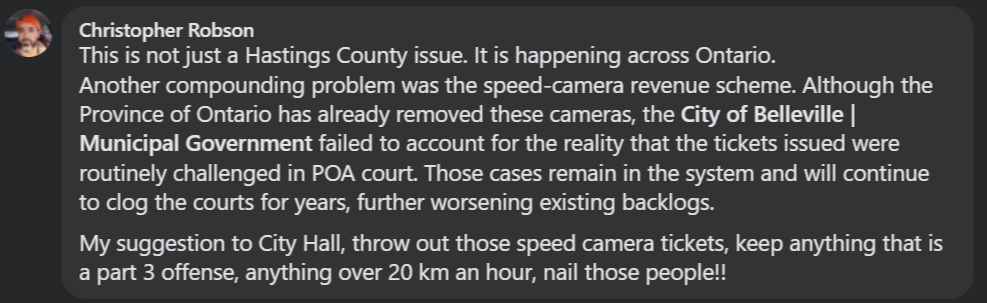
Robson calls it a “speed-camera revenue scheme” and he makes a compelling point. Even though the cameras may be gone, the thousands of automated tickets they generated are still moving through the python of the judicial system. Every contested speed camera ticket for a minor infraction takes up precious docket time. That is time that could be used for more serious offenses.
The Bottom Line
We are witnessing a clash between revenue generation and law and order. By prioritizing automated ticketing systems that acted as municipal cash cows, local governments may have inadvertently paralyzed the very courts needed to keep our streets safe from genuine threats.
We now have a situation where real police work is being thrown in the trash to make room for a backlog of automated fines. When bureaucracy trumps justice, the public loses.
What do you think? Should we throw out all remaining speed camera tickets to clear the courts for real crimes?




Unlocking the Canadian Defence Sandbox: How Quinte Innovators Can Use Speed and Local Muscle to Scale
TL;DR: Global defense is moving faster than government bureaucracy. The new Calian 100 million shared lab network gives Canadian startups...


The Ancient Superhighway: How a Tropical Drink Reached the Bay of Quite 2,000 Years Ago
TL;DR: Discover how 2,000-year-old pottery found in the St. Lawrence River reveals a massive prehistoric trade network. Ancient residents of...


From Trenton to Torino! The Quinte Skater Ready to Shock the World
TL;DR: Trenton’s Trennt Michaud has finally hit the Olympic ice in Italy with partner Lia Pereira. After a career-defining pivot...


How Rented Equipment Can Bankroll Your Belleville Summer
TL;DR: Spring has sprung in the Quinte region and homeowners are desperate to fix their messy yards. We break down...


Stop Grinding Alone: The Secret Support Network for Quinte Business Owners
TL;DR: Starting a business in the Bay of Quinte doesn't have to be a solo grind. Our region offers a...


How to Get Free of the 9 to 5 and Get Rich From Common Chores
TL;DR: This step-by-step guide breaks down how to ditch the grind and build a high-revenue service empire in your own...


The latest inductees into the Order of Canada has been released. We take a look at past Bay of Quinte inductees.
TL;DR: The 2026 Order of Canada inductees include pop culture icons like Nardwuar alongside Bay of Quinte legends who have...


6 Predictions for 2026: The Death of Job Hugging and the Rise of the Portfolio Professional
TL;DR: The Canadian dream is getting a massive update as we enter 2026. The traditional 9-to-5 is officially a legacy...


Is your Bay of Quinte property subject to Cowichan-style “clouded title”?
TL;DR: "Cowichan-style" property revolution could hit Ontario, specifically targeting the Bay of Quinte. For local homeowners and investors, the gold-standard...